
Quincy Public Schools has partnered with eSpark for nearly a decade. What began in 2015 as a pilot in a handful of elementary schools steadily expanded across the district, and by 2021, “every K-5 classroom was using eSpark to support reading & math. Today, Quincy students all benefit from the program’s adaptive pathways and personalized assignments for reading, writing, phonics and math instruction & practice.
For district leaders, this history matters. The relationship with eSpark has grown not only in scope but in trust. Teachers have seen the platform evolve to meet their needs, and administrators appreciate the consistent support, regular communication, and enhancements that reflect feedback from the classroom.
This long-term partnership positioned Quincy to meet a critical moment: supporting students after the pandemic while helping teachers adapt to new curricula without losing time or momentum.
Supporting Students and the Teachers Who Guide Them
When talking about her youngest learners, Erica Maynard affectionately refers to them as “our littles” — the kindergartners just beginning their school journey. In Quincy, teachers have noticed that many of these students enter school with varying levels of readiness, sometimes without the early literacy and numeracy foundations typically developed in preschool.
“Our littles that are coming in — we still see some gaps from those years and missing early intervention services. This year finally felt like a base line year where we could really focus on teachers and students and engagement again.”
— Erica Maynard, Director of Elementary Education, Quincy Public Schools
At the same time, district leaders knew teachers needed support too. With new HMH Into Reading and HMH Into Math curricula rolling out across Quincy Public Schools and a wide range of learning needs in every classroom, educators were stretched thin. Technology had proven valuable, but Quincy’s goal was to make it more intentional, not just a way to keep students busy but a meaningful tool to strengthen core instruction and engagement. Teachers say eSpark helped bridge the transition by aligning its lessons to the new curricula and simplifying differentiation during a year of change.

Scaling eSpark Premium+ for Over 2,000 Quincy Students
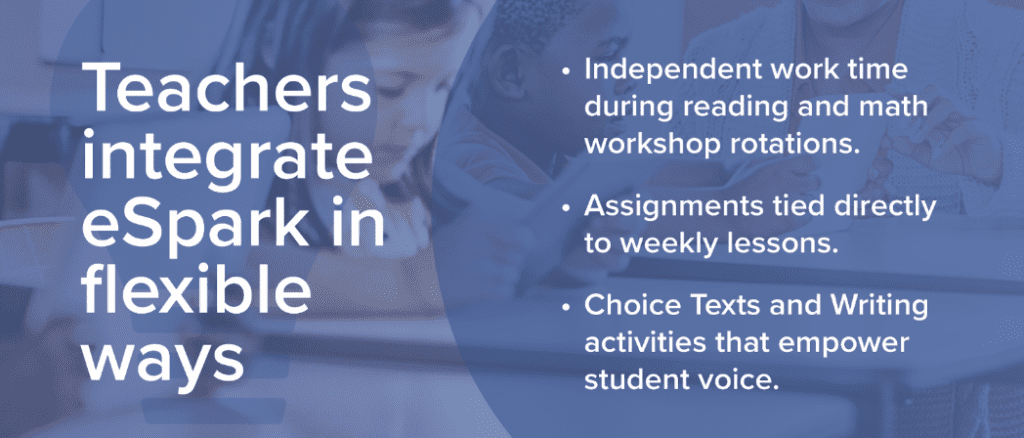
By 2021, Quincy had expanded eSpark district-wide, giving more than 2,000 K–5 students daily opportunities to build skills in reading, writing, phonics, and math through personalized and engaging instruction. What makes this adoption powerful is how seamlessly it fits into existing instruction: teachers weave eSpark into workshop rotations, assign targeted skills practice, and lean on adaptive Quests to meet every child where they are.
“I like that I can go back down to the lower levels, and that just meets my kids where I need it.” — Whitney Edwards, Fourth Grade Teacher, Isles Elementary
Instead of spending hours searching for or creating differentiated lessons, eSpark automatically generates adaptive pathways and personalized assignments aligned to classroom instruction. This flexibility allows teachers to tailor learning with precision, meeting students where they need support while continuing to challenge those ready to move ahead.
That “game changer” is Nova, eSpark’s AI-powered teaching assistant. Nova bridges the gap between the district’s core curriculum and adaptive instruction, ensuring every eSpark activity reinforces the lessons teachers are already delivering. For administrators, that alignment means the investments in new curricula extend further, helping students master key standards through consistent, personalized practice.
“Anytime we can relieve teachers of extra work, but students are still benefiting, that’s the number one takeaway for me.”
— Erica Maynard, Director of Elementary Education, Quincy Public Schools
When Student Voice Speaks Louder Than Lessons
Quincy teachers say one of the clearest signs of eSpark’s impact is when students start making connections between their independent learning and classroom instruction.
“It’s really fun when eSpark has taught them something, and then I go and I’m teaching a lesson on the curriculum and they’ll be like, ‘I just learned that in eSpark!’” — Katherine Leach, Fourth Grade Teacher, Isles Elementary
Moments like these show how eSpark helps students internalize concepts and build confidence – often becoming peer leaders when familiar topics resurface in class.
That sense of ownership extends beyond academics. One student used eSpark’s Choice Writing feature to create a heartfelt tribute to a beloved teacher who had passed away. eSpark’s system flagged the piece, allowing district leaders to share it as part of a school-wide memorial.
It was a powerful reminder that eSpark’s impact reaches beyond academics. In Quincy, it became a space where students could process emotions, express themselves, and feel seen by their community.

Quincy’s K–5 Students Surpass Growth Benchmarks
Quincy measures progress using the NWEA MAP Growth Assessment, and recent results show clear evidence of impact. In Winter 2024–25, students using eSpark not only met expectations – they significantly exceeded national growth benchmarks in both Reading and Math.Across the district, students who regularly used eSpark achieved an average growth percentile of 83 in Reading (compared to 73 for all students) and 76 in Math (compared to 69 for all students). These results demonstrate a clear connection between consistent eSpark usage and accelerated academic growth across both core subjects.
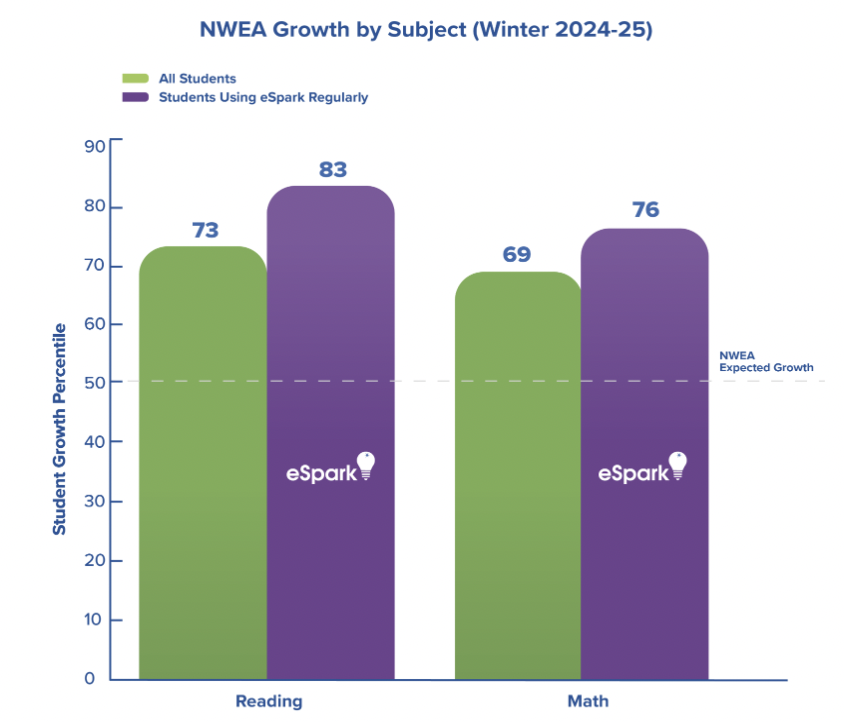
Students using eSpark scored 7–10 points higher in Reading and Math than their peers.
The equity impact is especially powerful. Among students who began the year in the lowest tercile of MAP performance, those using eSpark demonstrated even stronger gains – achieving an average 85th percentile in Reading and 83rd percentile in Math. These results outpaced both district averages and national growth benchmarks.
This progress shows that Quincy’s implementation of eSpark is helping to close opportunity gaps: the students who need the most support are making the greatest strides. Teachers attribute this growth to intentional, consistent use – embedding eSpark into workshop rotations, assigning targeted practice, and maintaining fidelity across classrooms.
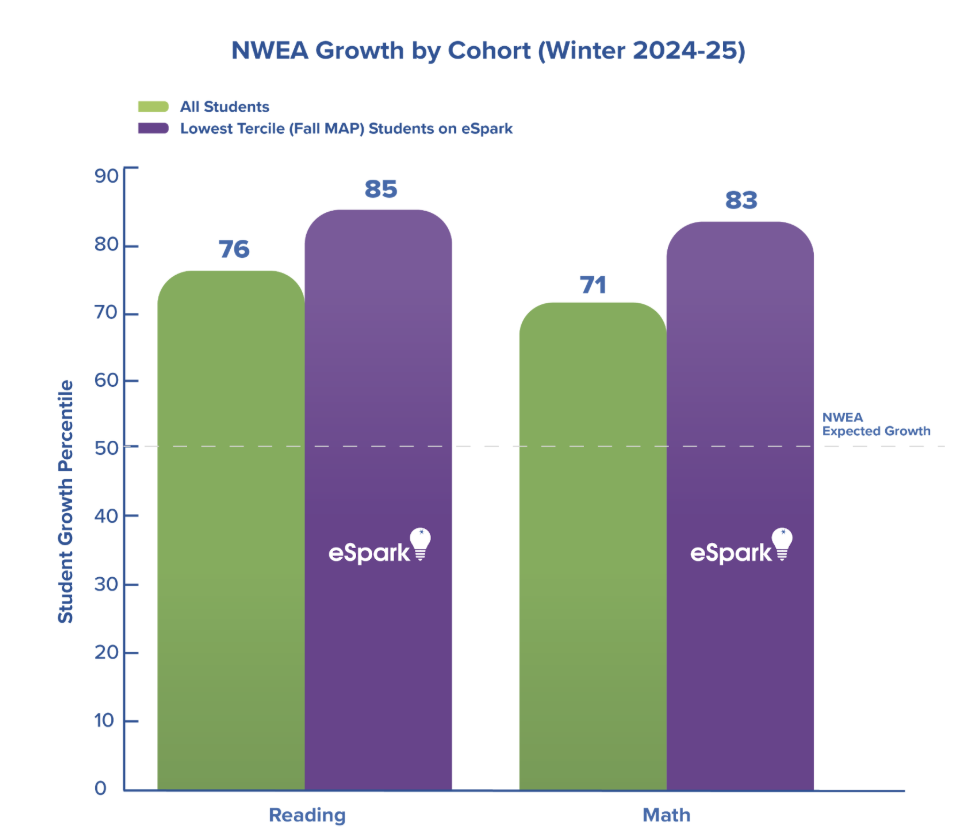
Quincy’s lowest-performing students made the strongest gains, outpacing both district averages and benchmarks.
Building Confidence Through Feedback
Across Quincy classrooms, eSpark’s instant feedback loop gives students visible, tangible motivation to stay engaged and push forward. Teachers say that moments of recognition, like earning a digital “high five,” have become powerful confidence builders that make students eager to keep growing.
“I think it’s the high five at the end. It’s like an immediate feedback of, ‘Oh, I knew what I was doing. I did a good job on this.’”
— Whitney Edwards, Fourth Grade Teacher, Isles Elementary
Those small moments of celebration translate into lasting confidence. Students approach new challenges with greater independence and pride in their progress, and teachers see stronger ownership of learning across subjects.
Sustainable Success Across Quincy Schools
For teachers, eSpark has become a true partner in planning – offering adaptable, curriculum-aligned lessons that let them focus more time on direct instruction and small-group support.
“It’s almost like there’s another teacher right here in the room with them.” — Katherine Leach, Fourth Grade Teacher, Isles Elementary
That added layer of support allows teachers to invest their energy where it matters most: connecting with students one-on-one, guiding small groups, and knowing every learner is supported through purposeful, aligned practice.
Across schools, student excitement has turned learning into something to celebrate.
“Our school does eSpark challenges, grade-level competitions, paper chains, even March Madness brackets. They get so into it that they forget it’s academic.”
— Katherine Leach, Fourth Grade Teacher, Isles Elementary
Teachers say this shared enthusiasm has transformed eSpark from a digital tool into a source of school pride. For students, it builds ownership and confidence – whether through Choice Texts, Writing, or phonics practice – turning independent work time into meaningful growth.
For district leaders, eSpark has become a strategic extension of their core curriculum – ensuring that the district’s investment in high-quality instructional materials delivers measurable results. By aligning adaptive practice with what teachers are already teaching, eSpark helps Quincy make the most of every instructional minute and every dollar spent on curriculum.
What’s Next: Curriculum Alignment + AI Support
With new reading and math curricula rolling out across K–5, Quincy educators are focused on helping teachers navigate change without losing valuable instructional time.
That’s where Nova, eSpark’s AI-powered teaching assistant, will play a pivotal role. By aligning personalized practice directly to Quincy’s new scope and sequence, Nova enables teachers to assign purposeful lessons, monitor progress, and support students at every level – with greater ease and precision.
For Quincy leaders, this next step is about more than adopting new technology. It’s about deepening a trusted partnership and maximizing the district’s curriculum investment – ensuring teachers have the support they need to focus on what matters most: student learning.
“I’m super excited that eSpark is connected to our curriculum now. That’s going to benefit classroom instruction in big ways.”
— Erica Maynard, Director of Elementary Education, Quincy Public Schools