
Mountain View Elementary School in Rio Rico, Arizona serves a small border-town community where many students arrive in kindergarten without formal preschool or early literacy exposure. For Instructional Coach Dede Alexander, this reality shapes every instructional decision. Her focus is clear: build strong foundational reading skills through personalized, small group instruction that meets each child where they are.
“We have many students coming in with no preschool and very little literacy experience,” Dede explained. “We often need to start at phonological awareness and the alphabetic principle, even in first and second grade.”
To meet these needs, Mountain View uses Savvas MyView and Amplify CKLA as core literacy curricula, along with tools like Raz Plus. But teachers still lacked an adaptive, aligned online component that could extend their small group instruction without increasing workload. They discovered eSpark during a professional development visit to another school, where they saw students deeply engaged with the activities.
Teachers began with the free version and quickly pressed for full access. “We needed more,” DeDe said. “We saw gaps we could not close alone at the teacher table.
Aligning Adaptive Practice to Small Group Instruction
Mountain View runs a consistent station rotation structure of teacher table, offline work, and online learning. The missing piece had been an adaptive online tool that aligned to the curriculum and supported the foundational reading skills teachers targeted each day.
“eSpark fit right into our model. It became the adaptive online component we did not have,” DeDe said.
Teachers now use eSpark to:
- Assign targeted practice aligned to their Amplify lessons
- Reinforce instruction from the small group table
- Provide students with individualized pathways informed by MAP Growth data
- Ensure students receive consistent skill building after direct instruction
The integration of MAP data has been particularly impactful. Mountain View’s teaching and learning team uploads MAP scores into eSpark so the platform can adjust pathways based on each student’s precise skill level. “That was a game changer,” DeDe noted. “It helped us get leadership completely on board.”
Easy to Implement and Fully Adopted
Implementation was intentionally simple. eSpark’s PD was short, practical, and easy to apply. Teachers quickly began assigning multiple targeted lessons per week.
“We can see how quickly the PD stuck. Assignment rates, minutes per week, and lesson completions went up right away,” DeDe said. “It is intuitive and teachers know students are getting what they need.”
Mountain View’s teachers value:
- The ease of finding and assigning aligned lessons
- The time saved during small group instruction
- The confidence that eSpark delivers high quality, adaptive practice
- The ability to focus their attention where it matters most
“Our teachers are learning a lot of new curriculum right now,” DeDe said. “eSpark was not another heavy lift. It was the opposite. It gave them one reliable piece that worked right away.”
Nova and Reading Lab, eSpark’s AI powered tools, have become essential for teachers who want quick, targeted assignments without additional planning time. Many now exceed the original goal of at least one assignment per week – students using eSpark are averaging 4.2 usage days per week, with 1500+ assignments via Nova.
Student Engagement That Drives Learning
For Mountain View students, eSpark has become something to look forward to. DeDe often sees students ask if they get to work on the platform during rotations.
“They want to know if they get to go to eSpark. They even ask if they get to go to the light bulb,” she said.
She also shared examples of students who typically struggle with attention but remain focused during eSpark activities. Interactive prompts, built in feedback, and opportunities to retry support students in staying engaged and building confidence.
“One first grade student who usually has a hard time staying focused was completely engaged. He asked to hear the question again, tried different options, and celebrated when he got it right. He could watch himself grow.”
Mountain View teachers reinforce this growth through classroom data walls and goal trackers. Even kindergarten and first grade students can see the lessons they have completed and how their progress is building over time.
Early Signs of Growth in Foundational Skills
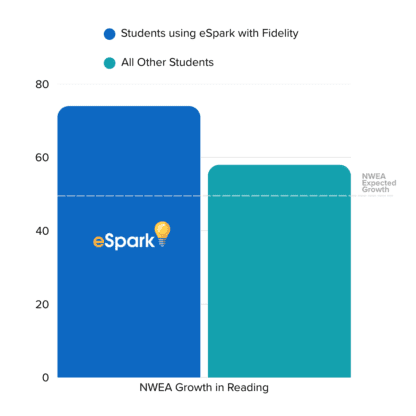
Although it’s still early in the school year, Mountain View is already seeing promising results across foundational literacy indicators.
“The clearest signs so far are our DIBELS and phonics screener results,” Dede said. “We are seeing fewer students who need Tier 3 intervention. More students are staying with their classroom teacher because they’re growing.”
Teachers and leadership attribute this shift to a consistent, aligned system where curriculum, data, intervention, and adaptive practice reinforce one another.
“All the pieces matter,” DeDe emphasized. “eSpark is one part of a larger system that’s working together.”
A Partnership Focused on Responsiveness and Support
Mountain View frequently reaches out to the eSpark team with questions or small adjustments, especially as they learn how to use Nova – eSpark’s new, AI-powered teacher assistant – and refine assignment practices. For DeDe, the responsiveness of the team has been essential.
“With a brand new product, we got an answer right away,” she said. “Our teachers don’t have time for delays. They need real time answers.”
Whether it’s clarifying how assignment clusters work or troubleshooting a classroom issue, Mountain View has found eSpark’s support quick and consistent.
Looking Ahead: Sustaining What Works
For Dede, stability is the priority. After years of shifting programs and rebuilding early literacy structures, she wants to maintain what is already working.
“Our goal for 2026 is to continue on the trajectory we are on now,” she said. “We want to keep the small group model, continue seeing gains on MAP and DIBELS, and deepen teachers’ intentional use of data.”
She is confident that eSpark will remain an essential part of that path.“If I were talking to another district leader, I would tell them we use eSpark because it supports students on an adaptive pathway and gives teachers peace of mind. They can trust what is happening. It fills the exact hole we needed. Our teachers even said, do not think about taking this away.”