Last week, the eSpark team made our way to Grand Rapids, Michigan for MACUL 2026 — one of the Midwest’s premier ed-tech conferences — and it did not disappoint.
Between our sponsor demo sessions on the exhibit floor and our featured Learning Session on Friday, March 20, we left Grand Rapids genuinely energized. Not just because of the conversations we had (though those were great), but because of what they confirmed: Michigan educators are doing hard, thoughtful, important work — and they’re hungry for real solutions.
📍 Grand Rapids, Michigan | 🗓️ March 18–20, 2026 | 🎤 Featured Learning Session + Exhibit Floor
🏛️ On the Exhibit Floor
Our team set up shop in the exhibit hall and spent two days talking with administrators, curriculum directors, coaches, and teachers from across Michigan. The through-line in nearly every conversation? The tension between the urgency of Michigan’s new literacy legislation and the reality of what curriculum transitions actually cost — in time, capacity, and teacher trust.
“We know we need to change, but we don’t know how to do it without burning people out.”
— A recurring theme from district leaders at MACUL 2026
That’s exactly the conversation we want to be in.
🎤 The Learning Session: Transforming Literacy Outcomes Together
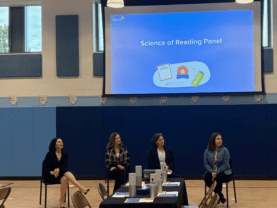
Catherine Einhaus, Executive Director of Elementary Curriculum and Programs at Utica Community Schools, led Friday’s session with the kind of candor and depth that only comes from someone who has actually lived through a major district transformation. eSpark’s VP of Pedagogy & District Relations, Becca Bishop, had the privilege of joining her to close out the conversation with a focus on eSpark’s long-standing role in the district alignment to the Science of Reading.
Utica Community Schools is one of Michigan’s largest districts, and their Science of Reading journey has been anything but simple. Catherine walked approximately 30 educators and district leaders through the full arc:
The Wake-Up Call
Significant K–3 skill gaps, many students below the 30th percentile, inconsistent phonics instruction
The Decision
A deliberate, multi-year process that led to selecting CKLA as their K–5 curriculum
The Rollout
Hard-won lessons from implementing district-wide — with a focus on teacher capacity first
🔭 The Three Lenses That Made Change Stick
What made this session stand out was the framework Catherine shared — a sequence she called the three lenses. Here’s what they looked like in practice:
👩🏫 The Educator Lens — First
Before any tool gets adopted, teacher knowledge has to be built. Utica trained 8 LETRS-trained district facilitators, developed a structured K–3 training sequence, and built a coaching infrastructure with 25 building-based literacy coaches on an 80/20 coaching-to-intervention model.
💡 Leadership principle: Teacher knowledge precedes tool adoption.
📚 The Resource Lens — Second
Materials have to reinforce the instructional shift — not compete with it. Utica used a Reading League-aligned evaluation rubric, convened a multi-role district committee, and narrowed a field of 10 vendors down to a 2-year pilot before landing on CKLA.
💻 The Technology Lens — Third
Only after instruction was strong did Utica introduce technology at scale — using eSpark to provide personalized pathways driven by NWEA MAP Growth data, biannual data refresh cycles, and teacher-assigned lessons aligned to current CKLA units.
Technology isn’t a shortcut. It’s a lever. 🔧
And it only works when the instructional foundation is solid.
📊 The Results Speak
The growth outcomes shared in the session made an impression. Students who consistently used eSpark saw remarkable gains — with the highest gains among students who started in the lowest percentile. The students who needed the most support benefited the most. That’s the kind of data that matters.
+10
percentile points
beyond expected growth in Reading 📖
+25
percentile points
beyond expected growth in Math 🧮
💡 What We’re Taking Home
A few things that stuck with us from the conversations this week:
Engagement metrics are not impact metrics.
Michigan educators are increasingly sophisticated about this distinction — they’re asking not just “are students using this?” but “is this moving the needle?”
Buy-in is built, not mandated.
The districts that succeed are the ones that leverage early adopters, offer optional high-value PD alongside mandated shifts, and equip teachers with ready-to-use resources that make change feel achievable.
Ask the right question.
It’s not “what technology should we adopt?” It’s “does this technology reinforce our current curriculum objectives, reduce teacher planning load, and produce actionable evidence?” If you can’t answer yes to all three, keep looking.
🙏 A Note on Our Partner
We’re grateful to Catherine Einhaus and the Utica Community Schools team for their willingness to share their story so openly. It was a genuine privilege to join Catherine on stage — her thoughtfulness, her commitment to getting this right for kids, and her ability to hold both the strategic and the human dimensions of this work simultaneously made this one of the most grounded, practical sessions we’ve been a part of.💬 Want to Keep the Conversation Going?
If you’re a Michigan district leader navigating a Science of Reading transition and wondering how technology fits into the picture, we’d love to connect.
📥
Download the Session Presentation
Get the full slide deck from our MACUL session, including the Curriculum–Tech Alignment framework and Utica’s implementation sequence.
📅
See how eSpark works in practice — personalized pathways, teacher-assigned lessons, and data that actually informs instruction. We’ll tailor the conversation to where your district is right now.
— The eSpark team